How to do your business's end-of-day cash count, step by step
What a cash count is, what you need before you start, the six steps to make it balance, the mistakes that throw it off and a free template to close your register every day.
 Arca7 min read
A cash count means comparing two numbers at closing: what should be in the drawer according to what you sold, and what's actually there when you count it. If the two match, the day balanced. If not, there's a difference, and a difference always has a cause.
It sounds simple, and it is. The hard part is doing it every day and in the same order, because a count you do "when there's time" never finds anything: by Thursday nobody remembers what happened on Monday.
What the cash count is for
- Knowing how much you sold today, and by which payment method: how much in cash, how much by card, how much by transfer and how much went on credit.
- Catching missing or extra money the same day, while you can still find out why.
- Setting tomorrow's float aside and taking out the rest, so the drawer doesn't hold more cash than it needs.
- Keeping a record by day. One isolated shortage is a mistake; a shortage that repeats every Tuesday is something else.
What you need before you start
A fixed cash float. It's the change you open with every day, always the same amount: $500, $1,000, whatever your business needs to make change in the morning. You write it down, you stick to it and you don't mix it with sales. If you open each day with whatever was left, the count will never balance, because you don't know where you're counting from.
And somewhere to record every sale with its payment method as it happens. A notebook works, a spreadsheet works better and a system does it on its own. What doesn't work is memory: the count compares against what was written down, and what wasn't written down doesn't exist.
The six steps
- Add up sales by payment method. Cash, card, transfer and credit, each on its own. Total sales is the sum of the four, but the drawer only cares about cash.
- Write down what left the drawer. The supplier you paid in cash, the change you went out to buy, the money you took out mid-afternoon. Every outflow with its reason.
- Work out what should be there: the float, plus cash sales, minus what went out. That's the number you'll compare against.
- Count the cash. Bill by bill and coin by coin, largest to smallest, and write down how many of each. Eyeballing it is the surest way to make it not balance.
- Get the difference: what you counted minus what should be there. Zero means it balanced. Negative means money is missing. Positive means there's extra, and extra is a mistake too: it's almost always a sale that wasn't recorded.
- Write down the cause and close. Set aside tomorrow's float, take out the rest and leave the count in writing: date, figures, difference, cause and who did it.
A sample count
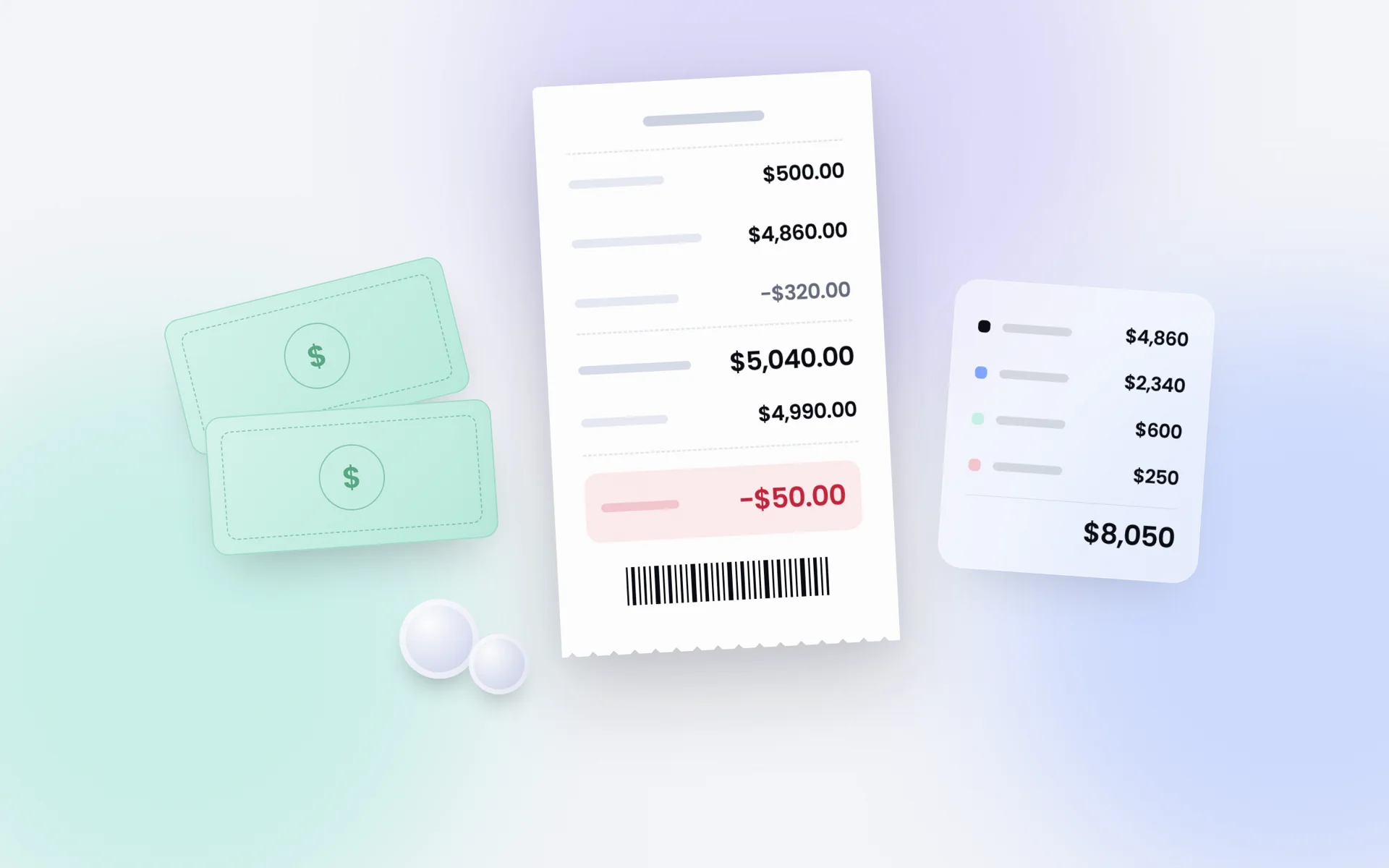
A stationery store opens with a $500 float. During the day it sells $4,860 in cash, $2,340 by card and $600 by transfer, and lets a regular customer take $250 on credit. Mid-morning it pays $320 in cash to a supplier who stopped by. At closing, there's $4,990 in the drawer.
| Item | Amount |
|---|---|
| Cash float | $500.00 |
| Cash sales | $4,860.00 |
| Left the drawer | −$320.00 |
| Should be in the drawer | $5,040.00 |
| Cash counted | $4,990.00 |
| Difference | −$50.00 |
$50 is missing. Card, transfer and credit don't enter the drawer math: they're sales, but not cash. Total sales for the day were $8,050; what gets compared with the count is only the $5,040. And the $50 has a cause: wrong change, a cash sale that wasn't recorded or an outflow that was forgotten. Today you can still find out which.
The mistakes that throw the count off
- Not writing down outflows. It's the number one cause. You pay the water delivery, the courier, the supplier who stopped by, and at night "money is missing".
- Mixing the float with sales. If you don't know what you opened with, you don't know what you sold. The float is always the same and gets set aside first.
- Counting credit as cash. It was sold, yes, but the money didn't come in. It goes on its own line, as what you're owed.
- Recording a card sale as cash, or the other way round. The day's total comes out right and the drawer comes out wrong, and nobody understands why.
- Making change from your pocket. If change comes from somewhere else, the drawer no longer reflects the day. Everything that comes in and goes out passes through the same place.
- Doing the count from memory. The figures are copied from what was recorded, not from what you think you sold.
How often to do it
Every day at closing. If you run shifts, at every shift change, because whoever hands over the drawer and whoever takes it have to agree on how much was in it. A weekly count lumps seven days of mistakes into one figure and you can no longer tell where any of them came from.
If you take payments in more than one place, each register gets its own count. Putting two drawers into one calculation is how one covers for the other.
How a system does it
When every sale is recorded as it happens with its payment method, the first three steps are done before you close: the system knows how much was sold in cash, how much went out and how much should be there. All that's left is counting the drawer and typing in the figure. In Arca the count comes out that way, by store and by who closed, and it stays on record so you can compare one day with another.
See how Arca records sales by payment method
In the meantime, the template above does the same math in the same order. The tool isn't what matters: what matters is counting the register every day, with the same float and every outflow written down.